
For too long, we’ve been kicking around dates to meet up at Mount Alto, share some wine, and catch up. It’s hot, and we’re in full drought right now in Central Virginia, but the overcast morning and nice breeze made sitting outside sipping and chatting amazing.
David and Robert are so engaging and have learned so much about growing wine grapes on their unique site in the past few years, and pour all that learning into growing grapes that produce exceptional wine. Over the course of the day, they took some time to walk through the vines with us and talk about how they’re tending the vines more than ten years into their project. What they’ve learned and how they now grow their vines sets them apart from others in the Monticello AVA and in Virginia, and demonstrates the intensity of connection between growing practice, site, and wine production.
I’d set up this visit because I was down to my last three bottles of Mount Alto’s signature red blend – the Manteo-Nason blend of Cabernet Sauvignon and Petit Verdot (you know I really try to save these things as library wines for some unspecified future event that may never happen). The 2019 was named Manteo-Nason-Tatum and since that incorporates my daughter-in-law’s name, I needed some more bottles to share when I see them in August.
Everything from the Site
Hubby, a friend and I showed up there – we knew it would be super hot but the day was overcast and the team had some shaded areas where we could sip and enjoy. They are so close to completing their winery facility on the site:
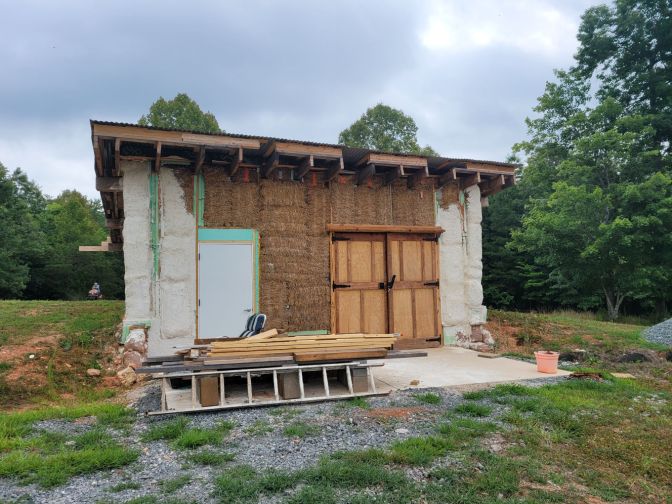
It’s going to take some more lime-plaster stucco to finish, but the building served them well over the winter, keeping the 2023 vintage safe inside. Aligned with the philosophy that governs their entire project, they built the building on site themselves, use stucco with a high pH to it so prevent microbial invasions, and are finishing with installation of a small air conditioning unit. They had solar panels in the truck with them, which they will install on the roof to power the building. Their aim is to create a self-sustaining system on the site, growing the grapes with only what is from the land, making the wine on the site, and powering it only with what is on the site. When we arrived to meet up with the team, Robert was just finishing spraying the tiny grapes – David quicky explained however, not with pesticides or dangerous chemicals, but with clay – to prevent sunburn on the grape skins. They also spray some organic “BT” to disrupt the reproductive cycle of the moths that could devour the vines. The importance of staying away from “forever chemicals” that would disrupt the wine and land is not lost on them.
They could easily tap into the power grid as some power lines run alongside the property, but it fits that this team is using solar – not because its trendy or cheaper (and getting the electric company to connect them to the grid probably would have been much easier!) but because generating their own power completes the cycle. The Mount Alto team has built everything on the site, occasionally using outside help to bring in equipment to clear the land, but then even reusing the trees that were cut to become the trellis posts and incorporate them into the buildings.
Coming to Understand this Land
Perhaps what is so fascinating about this place, and makes up part of why I enjoy the team and the wine so much, is how they’re approaching understanding their land and how the grape vines respond to it. This is truly a place of struggle for grapes. At this point, at the end of June, we see wineries posting pictures of small grapes but full bunches, and trellis systems crowded with big leafy vines.
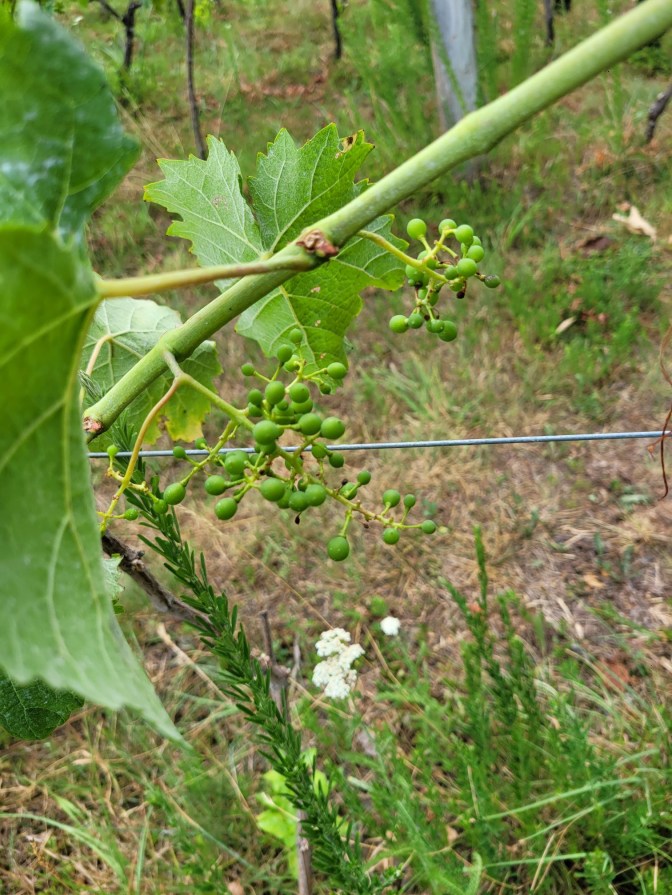
The vines at Mount Alto face such a struggle for water and nutrients, and the team is committed to natural production, so the vines have responded with limited vigor. While many in Virginia seek to maximize and push the grapevines to produce more, Robert and David have learned to be tremendously restrained, and use heavy pruning techniques to make the most of what the grapes can do. On some parts of the site the struggle is so great, minimal leaf reduction is needed. Where some would force the vines to produce up to 16 clusters of grapes per vine, they’re aiming for six to eight. With the level of struggle for water and nutrition from their specific site and the thin layer of loam here, the vines can only put so much forward to produce excellent wine grapes.

We spent a lot of time talking about the Single Guyot trellising method, and it was fascinating to hear. Our friend Cindy likened the process to crop rotation, letting a field rest for a year to rebuild nutrients, and focusing on another one to grow, and alternating the following year. While many wineries trellis two main spurs from the trunk of the vine, and grow shoots off both to grow their clusters, Mount Alto is focusing on one spur and letting the other rest – producing grapes off one spur this year and the other the next year. They’re trying this method for the first time and they think they’ve unlocked the secret here. I found this so interesting because my middle school science education taught me that plants store all their energy in their root systems underground when they are dormant and then pull it all back out to the farthest stems in the spring growing season. This implies that for our grape vines, the energy is really stored in the trunk and spur, and that the resting year allows significant regeneration and much better wine grapes the following year. Such interesting science and farming practice underlies our grapes, and goes against most of our other crop farming knowledge.
In our walk through the vines, they shared another story of incidental learning about their site that has helped them understand it and improve their farming. When the land was cleared, the debris from the trees cut down was simply piled on the hill away from where the vines were planted. The pile sat for about two years in that spot, and then logs were milled and repurposed all around the site. That location though, continues to have vines that show more vigor in their growth and produce more and fuller clusters. Merely two years of mild decomposition added lasting nutrients into this soil that continues to benefit the vines. That realization made Robert and David realize that they need to recycle organic materials from the site into compost to spread around the vines. They’re also attending to the balance the groundcover around the vines provides – while they want the vines to fight over the limited water, they also don’t need grasses and native plants and/or weeds soaking in nutrients the vines are desperate to get.
Even in a Really Tough Year, a Good Site Makes Good Wine
I’m so lucky to have gotten to know these folks. They opened and decanted a bottle of their first release, the 2018 Manteo-Nason blend. There are few bottles of this remaining in the world. If you remember 2018, it was a catastrophic year for much of Virginia winemaking. Heavy rains from hurricane remnants dominated the second half of the growing season and all of the harvest, and winegrowers watched grapes split and disintegrate on the vines. Few wineries made red wine that year and much of it was muted and diluted, soft, and much of the red grape harvest that did make it into a winery wound up as rosé. Mount Alto has a site that lets water just slide down the hill so that the vines don’t have much time to take it up, and that allowed their Cabernet Sauvignon grapes to make it to harvest, and as such, they were able to produce and bottle wine. Their story of the rainy night hoping they could get the grapes picked and to processing in time painted quite a picture of winegrowing in Virginia at its most intense.

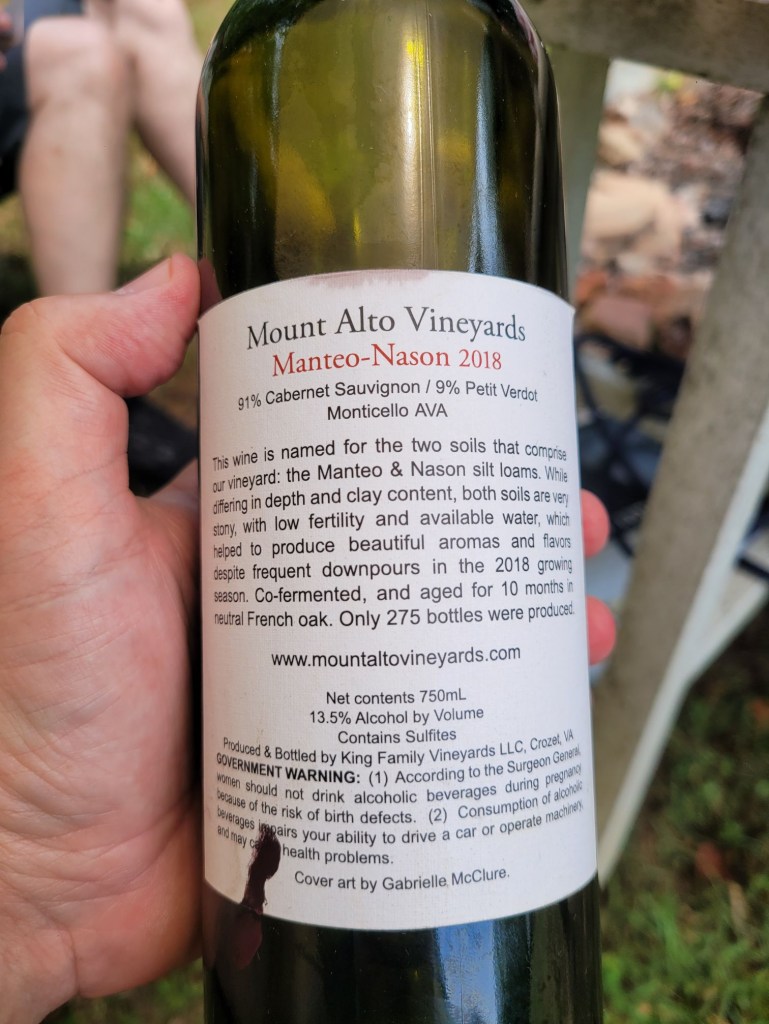
This blend had been kept in the A/C while decanting and was cool when poured. The first sip felt quiet, restrained and simple. It didn’t hold the power I often get from their blends after decanting. As it warmed, however, it really opened up and strong, rich tannins pushed through. Warm flavors of darker fruit slowly showed themselves. This wine did not pack the intensity their 2019 and 2021 blends usually carry, but it showed the what this site would yield in the future. I was very shocked by just how good this wine was, given the growing season it came from, and it validates that having a great site in Virginia is truly one of the keys to making great wine here. A great site doesn’t necessarily have to mean fertile soils rich in nutrients. In Virginia it really means a site that resists heavy rains by draining well and quickly, and resists the wild swings of weather to which we are prone.
One thing that surprises me about Mount Alto is that the vines are growing at 600 feet. As I’ve recently been learning more about high altitude vineyards like Ankida Ridge and Fox Meadow, I’m so fascinated by the ability of steep slopes to protect the vines from intense cold snaps. Six hundred feet doesn’t seem like a lot, but again, this site benefits from good fortune in their geography, having air masses move through the hills and keeping these babies from the very worst of the cold snaps we get. Their neighbors who grow grapes are at 800 feet, and seem to be very immune to the worst freezing – including the one winter that was so cold that Mount Alto lost about 150 vines, but they lost none. Site makes all the difference in the world in Virginia.
Unique, and Ultimately Reflective of Time and Place
What was so interesting to me is how all the pieces are coming together here. Because more plantings are coming of age and will be yielding grapes during this harvest season, and because they are applying all of these lessons learned over the past ten plus years on this site, they will increase their yield with this harvest, (I’m crossing my fingers, throwing salt over my shoulder, making offerings to various deities, etc) to be their biggest yet. It’s still small by comparison to other Monticello AVA wineries – they are expecting around 250 more pounds of grapes than last year and looking at a likely yield of about one ton. I’m used to hearing winegrowers speak to tons grapes from their site. While the small volume makes me sad, (I know they are likely to sell out of wines I adore), this is allowing them to focus intently on making some truly incredible wine. Under their current plan, the goal is to get to around 200-ish cases of wine per year. This level of production allows them to maintain tight control over all aspects and maintain their attention to what the vines and land are telling them they need.
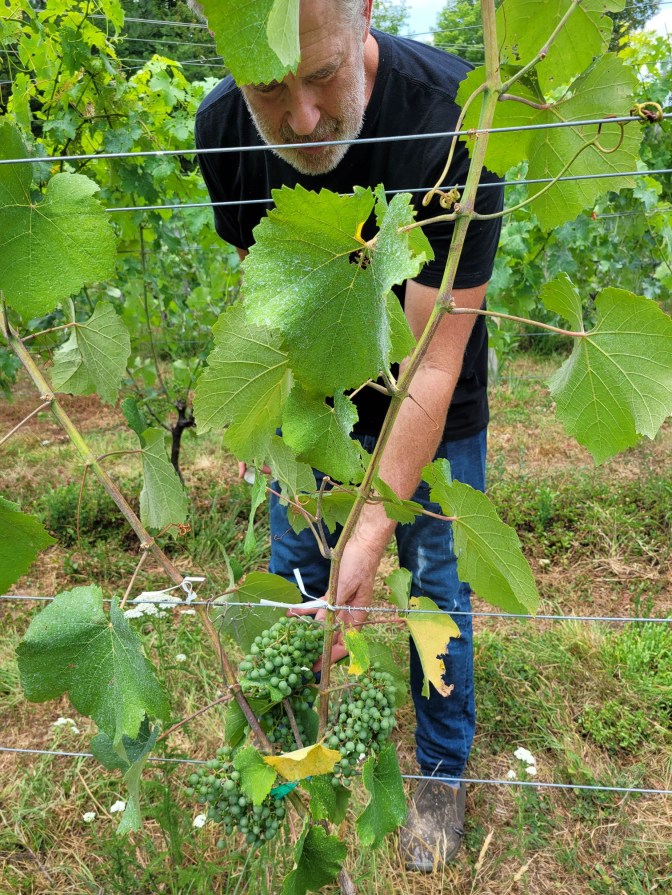
Mount Alto will hopefully release their Petit Verdot dominant red blend (they are naming it Tributary) in the fall, and I’m really looking forward to that. There will be a 2020 and 2021 version that I’ve had the honor of sipping samples of during previous visits. I asked how the 2023 wines were progressing and David shared that they are doing well in barrel, he is awaiting malolactic fermentation and not pushing them, but letting them run their course and develop. I suspect this is going to be a stunning vintage. Now that I’ve sampled each of their releases, I can see a progression of learning show up in their wines, and while aging certainly plays a factor in what we sense in the glass (and the five years now on the 2019 is showing amazing stuff) I think they’re finding the unique nature of the site and making the very most of its characteristics to produce a wine that is intensely reflective of time and place. They should teach a class on this, it’s at the very heart of what makes Virginia Wine special.
As I’ve shared previously, Mount Alto is a working farm – there is not a tasting room, there is no patio with Adirondack chairs (um, David and Robert, there’s an idea there) and you may visit by appointment only or find them at a pop up in Richmond, Charlottesville, and sometimes Blacksburg. They are well worth a drive and an afternoon of your time – simply wonderful wines and incredible company, with Robert’s mother Mary also joining the fun, sharing stories of her life and her impressions of the wines they’re making. You won’t regret making time to check out Mount Alto.
You Know the Drill….
It was hot and I forgot to get a good selfie or photo of myself in the shirt that also represents this space…

But it’s the one to have when you visit smaller production Virginia wineries. You can always check out the lineup here. Grab one today.

 My NoVa Wine Blog
What an insightful post! It’s fascinating to learn about the intricacies of growing grapes in each unique environment. The dedication and expertise required to cultivate high quality grapes really shine through in your write up. I really need to get out there and visit them!
LikeLiked by 1 person
Thank you! They are well worth a visit!!
LikeLiked by 1 person