
While the political landscape may put us all into manual labor in the not too distant future, I am fortunate to work in a role that requires more seated thinking and discussing and less labor. While part of me believes in a parallel universe where I own a vineyard—where, in this fantasy, I pour a little extra for kind and decent people at the tasting bar, and offer less (or nothing) to those who aren’t—reality is that the physical and mental demands of farming the land and managing a vineyard for a living are far beyond what I am capable of at this point in my life. I give major props to those who do this work day in and day out.
And so I reached out to Robert at Mount Alto to ask what pruning was like and see if I could be an assistant in their work preparing the vineyard for the 2025 vintage. For reasons I cannot fathom, he readily agreed and thus, the better part of this morning was spent at the vineyard in Esmont, pruning vines in rows eight and nine with Robert, Camila, David, and Mary. There is so much to learn and understand that supports the decisions that ultimately do impact the wine we enjoy four years from the snip with those shears.
This is my third actual experience that approximates what its like to work in wine. I have done a bottling experience at a winery a few years before this blog began (so many fascinating stories to tell about the wine before and after bottling and what was learned in that time), and last year hubby and I planted at Rubicon Vineyards as they put their first vines into the ground. Now I have done some light spring pruning, and I have to say, if there was no other takeaway from it, the thing that is impressive is how every decision that is made will impact the wine that is to come.
I arrived and the whole team had already started work, so I walked up, got a pair of shears and watched and listened as carefully as I could. I can honestly tell you that while my brain was ready for “Find the healthiest shoots and keep them trim the weak ones away” this is not what we did. Farming grapes goes against what seems “wise” at the time.
Robert took the time to teach me about the vine branch that shows “continuity” on each side (each vine in the Guyot pruning system they use has two main growth “spur” branches and one cane); the idea is to find the pathway through which sap most easily flows and in which the plant intends to focus energy growing. Mount Alto allows the left side to rest in odd growing years and focuses on heavy growth on the right side – this is the Guyot-Poussard pruning method. Thus we left two branches on the right (a continuity branch and a branch that would be a spur) and one continuity branch on the left. The left gets a growing season to recover and the vine puts a ton of effort into growth on the right side, producing more (and better) fruit there. This method also respects the vine’s sap flow, and allows that to strengthen, which appears to have an effect of preventing disease. Future pruning will reinforce this approach and continue strengthening the primary sap flow routes.


I found myself often triple-guessing myself and doubting my selections, and about half the time Robert or Mary talked me through changing my mind and cutting a different branch off.
The other stressful part was tying the branches down on the wires so they could effectively serve as canes to grow shoots up into the trellising system and get solar energy and hang grapes. The branches were stiff and brittle and made all kinds of cracking sounds as I bent them. Robert was much less concerned than me and did this with ease and bent them far past what I believed was the breaking point, but I guess I need to get comfortable with being uncomfortable (a motto for my life, as well as for vineyard pruning).
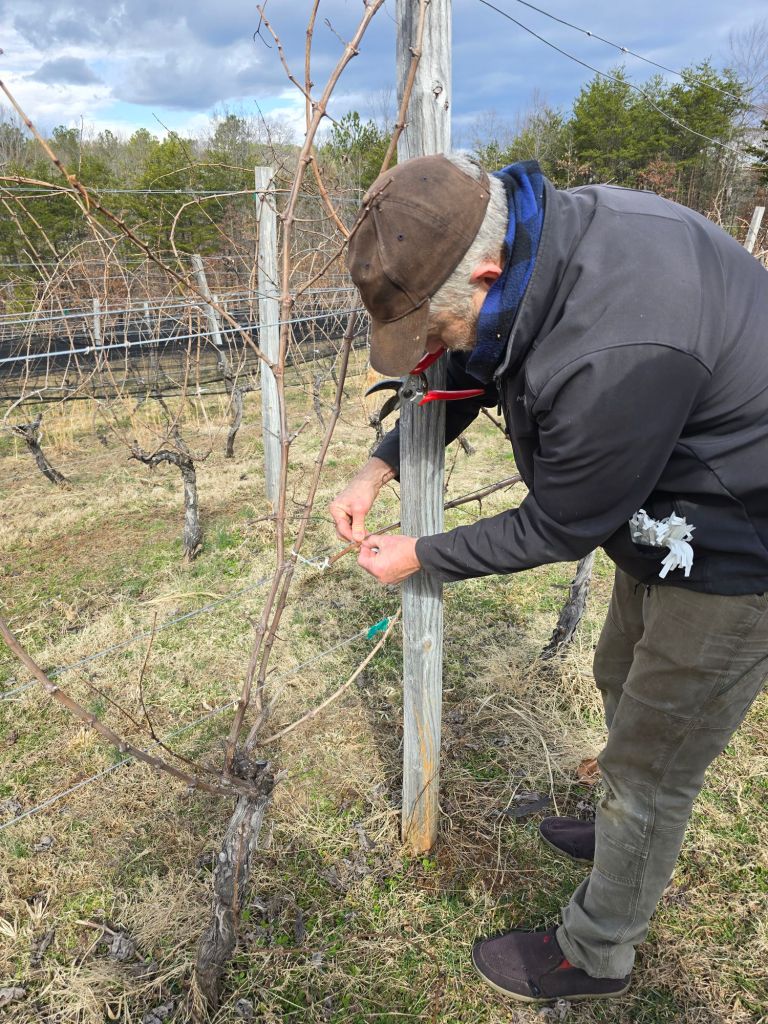

Over the course of two or three hours we completed two full rows of Cabernet Sauvignon. While the work was not simple, it was not nearly as exhausting as planting. There is a certain calm in it too, as you continue to move through the vines and find a routine. Many vines were fairly straight-forward, but some took time, thought and discussion to determine which branch showed continuity and which should be removed to optimize the vine’s productivity in the season. My standard joke was “sorry about that bottle from the 2025 vintage I just cut off…” but they reassured me that mostly what I was seeing was the results of all their previous mistakes in the vineyard. They’re all such good people.
Once we completed the rows, we gathered the cuttings for their compost pile at the bottom of the hill. We headed back to the top of the property and settled in for lunch and wine. David had recently been to the Finger Lakes region and brought back a charming Saperavi and Cabernet Sauvignon/Saperavi/Petit Verdot blend that we enjoyed while eating country ham sandwiches and some delicious fresh-made cookies. Then the epic fun began.
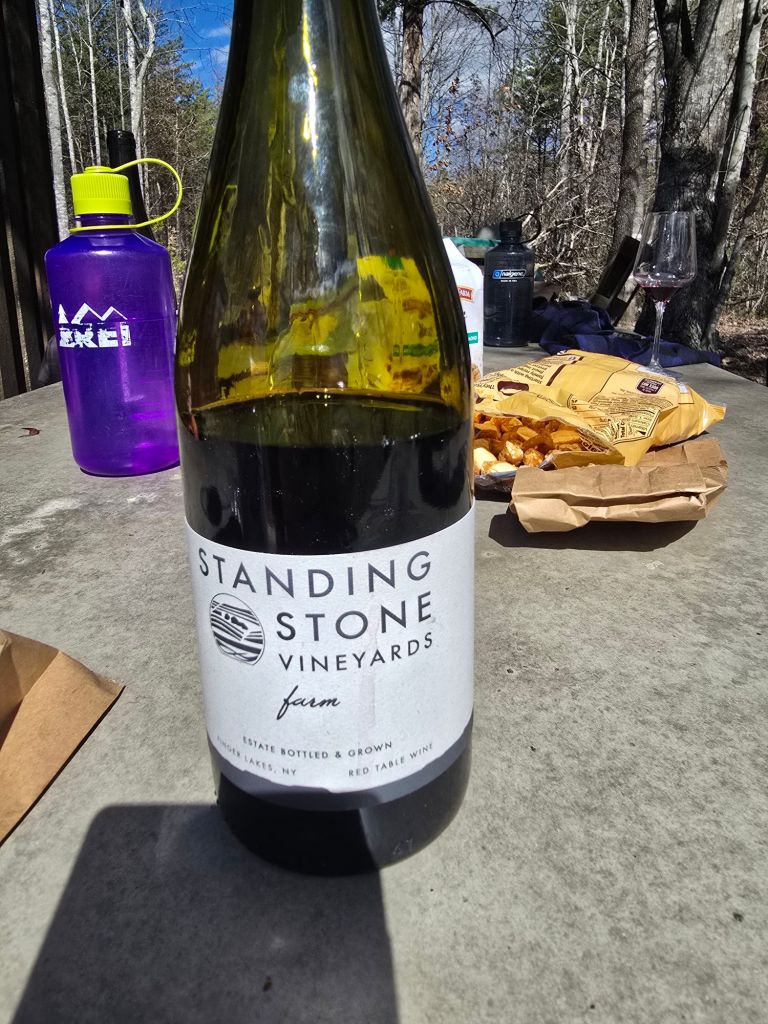

I’m always curious about Saperavi because I see so little in Virginia, and while this wine was not Virginia, it was absolutely amazing. There were pleasant tannins and clean fruit to enjoy throughout this wine. What came next was unexpected, however.

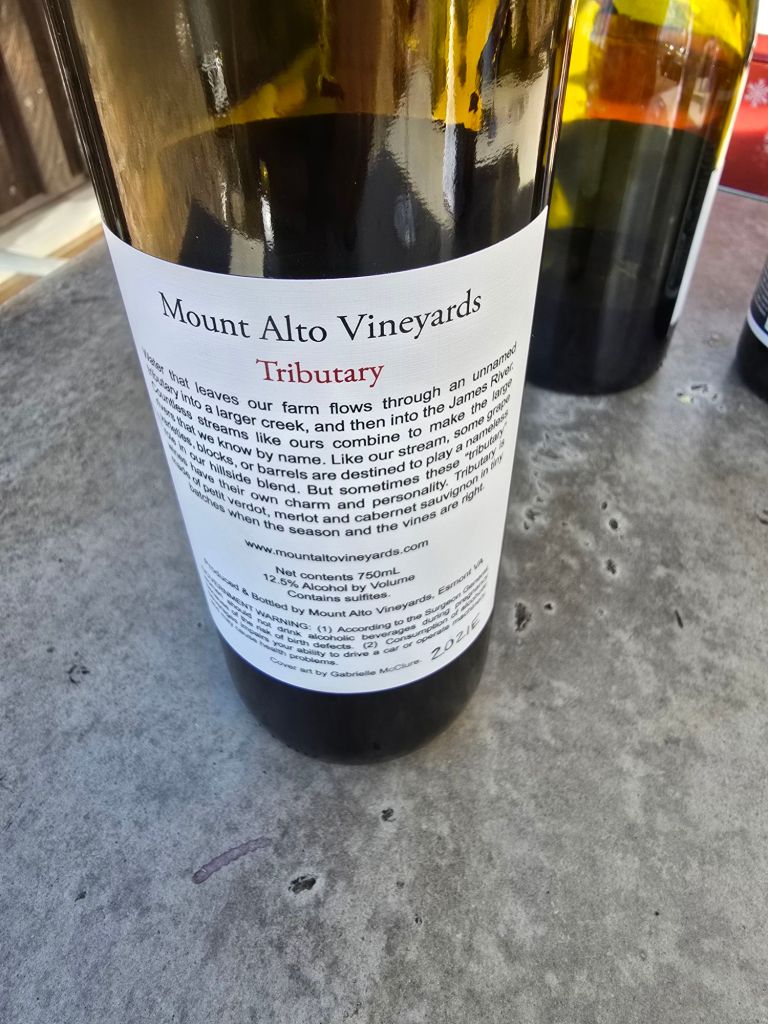
The 2021 Tributary Estate – all Petite Verdot from the property. This blew my socks off – musky leather on the nose and palate. All that I love about Petit Verdot was present here – rich, earthy fruit flavors that last a long time and leave your mouth dry. This was an incredible wine, and I *may* just have scored a bottle to take home. Sadly, this is not widely available, and there is not much left. But I will continue to dream of Petit Verdot and picture this one. Gonna try to save this for you, Favorite Brother-in-law!
We also headed into the production space and sampled 2022, 2023 and 2024 from barrels and tank. The 2022 has a smooth subtle taste, all from the property and primarily Cabernet Sauvignon with some Petit Verdot. But then we experimented with a sample of the 2024 Merlot the team purchased from Grace Estate last year – we tasted the Merlot and then blended it with the 2022 Manteo-Nason as it is now. The Merlot was aged in new oak and carries a heavy influence from it. But when a component blended with the 2022, it has a multiplicative effect. The two together brought out a completely different profile – much different from the sum of its parts. I’d happily have the 2022’s soft, pleasant tannic structure all day long, but with the Merlot blended in, something else was happening. This was a lot of fun, and could become the ultimate bottling and release. Fingers crossed that bottling is coming soon!
We also sampled the 2023 blend from the barrel where it’s aging. I had this previously at my last visit, and it was showing up just as beautifully now. This wine is one I’d buy right now, and I suspect it will just continue to develop in barrel. I have no idea when this will end up bottled and released, but this wine is developing and tremendously special. Oh Vintage 2023, you may bankrupt me yet.
We then sampled some Cabernet Sauvignon from the small new oak barrel they have. I smelled root beer and vanilla on this, and that is what showed up in taste too – the influence of that powerful oak. The silky undertones we expect from Mount Alto were definitely there, and they showed more clearly in the 2024 blend from the neutral barrel. The 2024 Cabernet Sauvignon when blended with the neutral barrel will have some really interesting layers to it. The neutral oak blend was a bit wound up, but still showing similar tannins to the 2023 – they weren’t as deep and broad, but given the long dry growing season, they are still strong. This wine will be exciting to watch develop.
Every visit to Mount Alto is time well spent. The team is so great to shoot the breeze with and talk wine with, and the wine is, as always, spectacular. Learning so much about their approach to pruning, and how that sets the tone for the type of wine they want to make, was some of the most fun I’ve had recently. I have so much respect for our growers and makers here in Virginia. Every decision is consequential, and given the lower productivity of vines here, essential to ensure your winery can thrive. Thoughtful approaches that respect the structure of the vine, such as the Guyot-Poussard method, ensure the sustainability and health of each vine, and reflect other choices around sustainability and winemaking.
You can find a very limited supply of Mount Alto’s wines in a few boutique wine stores like the Wine Guild in Charlottesville and Barrel Thief in Richmond. You are best served by reaching out to them through their website if you want to check out their wine – you can book some time with them on the property, and enjoy some great company while you enjoy your wine. Watch this space, because you will hear here when the next release is on the way, and you will want to move fast, since the wine will!
Speaking of moving fast, you don’t need to worry about these shirts moving fast, but you do need to order one now. They’re still around and they’re still fun. I wore the OG design on a sweatshirt while pruning, and it kept me warm in the cool morning breeze that day. You’ll love them, and if I see you in one at a winery, your glass is on me. Get one!


 My NoVa Wine Blog
3 thoughts on “The Art and Science of Pruning: A Morning with Mount Alto”